Legislative Notice--H.R. 933
Noteworthy
Background: H.R. 933 was introduced by Rep. Hal Rogers on March 4, 2013. The House passed H.R. 933 on March 6 by a vote of 267-151.
Floor Situation: The Senate is expected to consider H.R. 933 during the week of March 11.
Executive Summary: H.R. 933 includes appropriations bills for the departments of Defense and Veterans Affairs, and a continuing resolution for the remainder of the federal government. CBO reports that H.R. 933 is in compliance with the Budget Control Act’s cap on regular discretionary budget authority of $1.043 trillion for fiscal year 2013. The sequester would apply to this funding, bringing total 2013 budget authority to $984 billion.
Overview
The Congressional Budget Office (CBO) reports that H.R. 933 would provide regular discretionary budget authority of $1.043 trillion, consistent with the Budget Control Act’s spending caps. However, the sequester would apply to this amount. Post-sequester, total regular discretionary budget authority would total $984 billion. After including Overseas Contingency Operations (OCO) funding and disaster/emergency funding, post-sequester discretionary budget authority in 2013 will total $1.127 trillion.
Sequestration will apply to funds provided in this bill regardless of the funding level enacted for in fiscal year 2013. For example, even if this bill funded regular discretionary budget authority at $984 billion before any sequester, sequestration would still apply. This is because Section 251A of the Balanced Budget and Emergency Deficit Control Act of 1985 (as amended by Section 302 of the Budget Control Act of 2011) requires sequestration if a bill saving $1.2 trillion was not reported by the Joint Select Committee on Deficit Reduction and enacted into law. Since the Joint Select Committee did not produce a bill, sequestration has been triggered under current law.
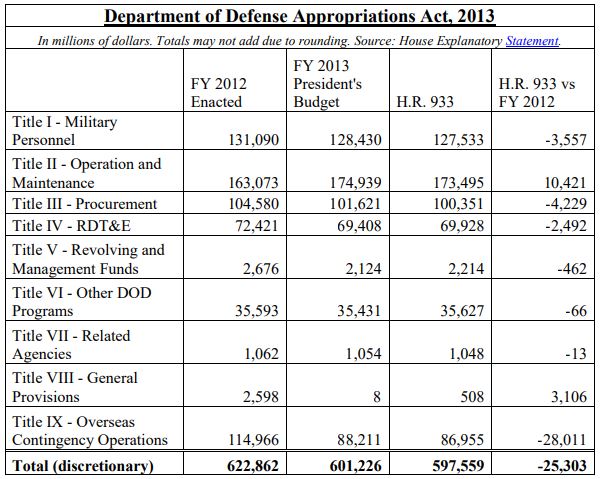
Division A provides $518.1 billion for the Department of Defense’s base budget, which is approximately equivalent to the amount provided in fiscal year 2012; and $87.2 billion in OCO funding. The Administration’s fiscal year 2013 request for the discretionary base budget of the Department of Defense was $525.4 billion and $88.5 billion for Overseas Contingency Operations. The Continuing Resolution the Department is currently operating under provides the equivalent to a year-long appropriation of $519.9 billion for the base budget and $88.5 billion for OCO.
Division B provides $133.9 billion in total funding for the Department of Veterans Affairs, of which $61 billion is in discretionary spending. It provides $10.6 billion for military construction. The Administration’s fiscal year 2013 request for these funds were $135.6 billion for Veterans Affairs, $11.2 billion for military construction and family housing, and $219.5 million for related agencies. Of this amount, $74.4 billion was for discretionary appropriations, with the remainder considered mandatory. Veterans’ benefits are exempt from sequestration.
Division C contains the continuing resolution for the remaining departments and agencies of the federal government.
Division D contains across the board reductions necessary to comply with the Budget Control Act spending caps. The total savings of both across the board reductions is approximately $1.2 billion, and this reduction is in addition to sequestration cuts.
Bill Provisions
Division A – Department of Defense Appropriations Act, 2013
Division A of the House-passed Continuing Resolution, H.R. 933, provides an appropriations bill for the Department of Defense for the remainder of fiscal year 2013. The Administration’s fiscal year 2013 request for the discretionary base budget of the Department of Defense was $525.4 billion and $88.5 billion for Overseas Contingency Operations. The Continuing Resolution the Department is currently operating under provides the equivalent to a year-long appropriation of $519.9 billion for the base budget and $88.5 billion for OCO.
The Budget Control Act provided a cap on all of “security” spending of $684 billion. For fiscal year 2013, this category “comprises discretionary appropriations for the Departments of Defense, Homeland Security, and Veterans Affairs; the National Nuclear Security Administration; the intelligence community management account (Treasury account 95-0401-0-1-054); and discretionary accounts related to international affairs (budget function 150).” The Congressional Budget Office estimates that if security spending had continued to be appropriated at the rate of the current Continuing Resolution, spending would have exceeded the Budget Control Act cap for security spending by $6.8 billion.
Therefore, this Continuing Resolution, H.R. 933, provides $518.1 billion for the base budget, which is approximately equivalent to the amount provided in fiscal year 2012; and $87.2 billion in OCO funding. This funding is all subject to the sequester rescission/cancellation, but OCO funding does not count toward the spending cap.
The bill also provides limited flexibility to the Department of Defense in implementing the sequester this year. The Administration in its reports to Congress has said it is required to implement sequestration by applying cuts “equally at the program, project, and activity level within each budget account.” The Joint Explanatory Statement makes an exception for this for both military personnel and operation and maintenance accounts, defining “program, project, and activity” at the account level for these two accounts. Military Personnel accounts have already been made exempt from the sequester.
Division A Provisions of Note
Title IX includes various provisions:
- Section 9002 provides $3.5 billion in general transfer authority.
- Section 9005 limits to $200 million the total monies that may be obligated within the Army Operation and Maintenance Account to fund Commander’s Emergency Response Program (CERP) projects in Afghanistan, provided that no single project may exceed $20 million.
- Section 9014 provides that none of the funds made available in the Defense-Wide Operation and Maintenance Account may be used for certain reimbursements to Pakistan until the Secretary of Defense certifies Pakistan is:
- cooperating in efforts against terrorist organizations, such as the Haqqani Network, the Quetta Shura Taliban, Lashkar e-Tayyiba, and al Qaeda, including taking steps to end support for such groups and prevent them from operating in Pakistan and carrying out cross border attacks into neighboring countries;
- not supporting terrorist activities against U.S. or coalition forces in Afghanistan;
- dismantling improved explosive device (IED) networks and interdicting precursor chemicals used in the manufacture of IEDs;
- preventing the proliferation of nuclear material; and
- issuing visas in a timely manner for U.S. visitors engaged in counterterrorism efforts and assistance programs in Pakistan.
Division B – Military Construction and Veterans Affairs, and Related Agencies Appropriations Act, 2013
Division B of the House-passed Continuing Resolution, H.R. 933, provides an appropriations bill for Military Construction and Veterans Affairs. The Administration’s fiscal year 2013 request for these funds were $135.6 billion for veterans affairs, $11.2 billion for military construction and family housing, and $219.5 million for related agencies. Of this amount, $74.4 billion was for discretionary appropriations, with the remainder considered mandatory. Veterans’ benefits are exempt from sequestration.
The House Appropriations Committee reports that H.R. 933 provides $133.9 billion in total funding for the Department of Veterans Affairs, of which $61 billion is in discretionary spending. It provides $10.6 billion for military construction.
The House Appropriations Committee says this is $210 million more than was provided for fiscal year 2012.
Division B Provisions of Note
- Section 511 provides that no funds may be used to construct or otherwise modify any facility in the United States for the purposes of holding in Department of Defense custody a Guantanamo detainee.
Division C – Full Year Continuing Appropriations Act, 2013
Title I – General Provisions
Section 1101
This section provides budget authority in fiscal year 2013 for projects and activities that were funded in fiscal year 2012.
Section 1102
This section provides that the fiscal year 2013 CR funding shall be governed by provisions in the applicable fiscal year 2012 appropriations Act.
Section 1103
This section provides that program funding provided in the CR will retain identical periods of funding availability as program funding in fiscal year 2012.
Section 1104
This section provides that no project or activity may receive funds if it was not funded in fiscal year 2012.
Section 1105
This section states that all requirements that were attached to fiscal year 2012 appropriations are still active requirements for this CR funding through September 30, 2013.
Section 1106
This section states that the CR will provide funding through September 30, 2013.
Section 1107
This section provides that expenditures made under the earlier fiscal year 2013 CR (P.L. 112-175) will count towards funding totals in H.R. 933.
Section 1108
This section allows CR funds to be obligated and spent notwithstanding several provisions of U.S. Code that prohibit obligation and expenditure of an appropriation that is unauthorized or exceeds the authorized amount: (1) 22 USC 2412 regarding foreign assistance; (2) 22 USC 2680 regarding the State Department; and (3) 22 USC 6212 regarding the Broadcasting Board of Governors.
Section 1109
This section allows mandatory outlays to continue at rates provided for in current law. This section also provides for advance payments for the following mandatory spending: (1) $40 million for Special Benefits for Disabled Coal Miners, (2) $106.3 billion for Medicaid grants to states, (3) $1.1 billion for Child Support Enforcement and Family Support Programs, (4) $2.2 billion for foster care and adoption assistance, and (5) $19.3 billion for Supplemental Security Income.
Section 1110
This section makes budgetary designations for OCO funding, disaster funding, and Social Security administrative funding.
Section 1111
This section provides advance appropriations for any account that received advance appropriations in fiscal year 2012, at the same funding level.
Section 1112
This section extends the federal employee pay freeze until December 31, 2013. P.L. 111-322 had extended the pay freeze until December 31, 2012, and P.L. 112-175 extended it until March 27, 2013.
Section 1113
This section contains reporting requirements for agencies and departments funded by Division C.
Section 1114
This section requires OMB to submit monthly reports to the appropriations committees on funding made available by Division C.
Titles II through XI
These titles make various adjustments to funding levels and requirements in Division C. The most notable provisions include:
- NOAA: Providing $802 million for work to continue on new weather satellites.
- NASA: $2.119 billion for the “heavy lift launch vehicle system,” an increase from the 2012 funding of $1.86 billion; and $525 million for commercial spaceflight, an increase from $406 million.
- Customs and Border Protection: Requires the CBP to maintain current staffing levels.
- Immigration and Customs Enforcement: Requires ICE to maintain a minimum of 34,000 detention beds.
- Department of Energy: Section 1401 provides that notwithstanding the other provisions of the bill, $7.58 billion shall be available for nuclear weapons activities at the Department of Energy. This is approximately $300 million less than President Obama said was needed in this fiscal year when he presented his nuclear modernization plan in exchange for Senate ratification of New START. This amount would also be lessened by the sequester this fiscal year.
- State Department: Section 2001 provides that notwithstanding the other provisions of the bill, $4.17 billion shall be available in OCO funding for the Administration of Foreign Affairs, Diplomatic and Consular Programs at the Department of State, of which $952.7 million is for Worldwide Security Protection. It further provides $1.36 billion shall be appropriated in OCO funding for Embassy Security, Construction, and Maintenance at the Department of State. It also requires a report on embassy security.
- Postal Service: H.R. 933 is silent on the U.S. Postal Service, and this has the effect of continuing for the remainder of this fiscal year the provision in the FY 2012 appropriations act that provided payments to the USPS. That act provided “[t]hat 6-day delivery and rural delivery of mail shall continue at not less than the 1983 level.” The USPS has announced its intention to end Saturday delivery the week of August 5, 2013.
Division D – Across the Board Reductions
This division contains across the board reductions of 0.098 percent to non-security spending contained in divisions A through C, and 0.109 percent to security spending contained in divisions A through C. This provision lowers the bill’s discretionary spending limits to comply with the Budget Control Act’s caps. The total savings of both across the board reductions is approximately $1.2 billion, and this reduction is in addition to sequestration cuts. The across the board cut does not apply to OCO funding or to funding provided to the Social Security Administration for disability reviews.
Administration Position
The Statement of Administration Policy expresses concerns about H.R. 933 but does not address the possibility of a veto.
Cost
CBO reports that H.R. 933 would provide regular discretionary budget authority of $1.043 trillion, consistent with the Budget Control Act’s spending caps. However, the sequester would apply to this amount. Post-sequester, total regular discretionary budget authority would total $984 billion. After including OCO funding and disaster/emergency funding, post-sequester discretionary budget authority in 2013 will total $1.127 trillion.
Possible Amendments
The amendment situation is unclear at this time.