Legislative Notice: S. Con. Res. 8 – Concurrent Resolution on the Budget for Fiscal Year 2014
Noteworthy
- Background: Senate Democrats are bringing a budget resolution to the Senate floor for the first time in four years. S.Con.Res. 8 was reported out of the Budget Committee on a 12-10 vote, S. Rept. 113-12.
- Floor Situation: The Senate will consider the fiscal year 2014 budget resolution during the week of March 18. Debate time is limited to 50 hours. Upon the use or yielding back of the 50 hours, the Senate will begin a “vote-a-rama” on amendments. Some amendments may receive votes during the week before vote-a-rama begins.
- Executive Summary: S. Con. Res. 8 increases spending by $645 billion over 10 years and increases taxes by $1.5 trillion. Including the effects of a new stimulus included in the resolution, this budget increases spending by $691 billion relative to making no changes in current law. The national debt in 2023 would total $24.4 trillion, or 94 percent of GDP under the Democrats’ budget.
Overview
The Democratic budget resolution contains total 10-year spending of $46.4 trillion, an increase of $645 billion relative to a current law baseline that excludes war spending. In its baseline, the budget resolution includes a repeal of the Budget Control Act sequester, estimated by the CBO to cost $995 billion, plus an additional $228 billion in interest costs. By assuming the sequester is canceled, but not proposing any specific offset, the Democratic budget can claim $1.2 trillion in higher deficit reduction. The resolution would increase mandatory spending by $25 billion over the 10 year period.
The tax increase in the Democratic budget resolution is a minimum of $923 billion over 10 years. If reserve funds relating to sequester repeal and stimulus are used as recommended by Budget Committee Chairman Murray in her report, that tax increase would reach $1.5 trillion. The Committee print makes it clear that Democrats intend to increase taxes by an additional $580 to offset infrastructure increases and to turn off part of the sequester.
Democrats say that their budget resolution reduces deficits by $1.85 trillion. However, actual deficit reduction is significantly less since the Democrats measure the effects of their policies relative to a baseline that they created (not the CBO baseline), which assumes the sequester is canceled but not offset, among other gimmicks. There is no deficit reduction in this budget in the first year, 2014.
Gross debt at the end of the 10-year budget window will be $24.4 trillion, or 94 percent of GDP under the Democrat budget. By comparison, gross debt under an analogous CBO current law baseline would be $24.6 trillion.
Debate Structure
Under the Budget Act of 1974, as amended, a budget resolution is a privileged piece of legislation. It is not subject to filibuster, and debate time is limited to 50 hours, equally divided. There are sub-limits within the overall time limitation, such as a two-hour cap on any first-degree amendment and a one-hour limit on any second-degree amendment, debatable motion, or appeal. Time can be yielded back. Votes do not count against the 50-hour time limit, nor do quorum calls just prior to votes.
Amendments to the budget resolution must be germane. A point of order lies against non-germane amendments, and 60 votes are required to waive the point of order. Germane amendments are those which:
1) Strike language;
2) Increase or decrease numbers;
3) Add language that restricts some power in the resolution;
4) Add language that is germane to other language in the resolution; or
5) Change dates
Debate on first-degree amendments is limited to two hours – one hour to proponents and one hour to opponents. Debate on second-degree amendments is limited to one hour – 30 minutes to proponents and 30 minutes to opponents. All debate time on a first-degree amendment must be used or yielded back before a second-degree amendment can be offered.
Debate on any motion to waive a point of order is limited to one hour, equally divided. Amendments can be offered at any time.
In the Senate, a motion to recommit is not in order except a motion to recommit with instructions to report back within a specific number of days (no more than three, not counting any day in which the Senate is not in session). Debate on the motion is limited to one hour, equally divided, and controlled by the mover and the manager of the budget resolution.
Once all debate time has been used or yielded back, Senators may continue to offer further amendments. No debate is in order, but roll call votes can be taken. Dozens of votes may occur with little or no explanation; this is known as “vote-a-rama.” Once all amendments have been dispensed with, a vote on final passage occurs.
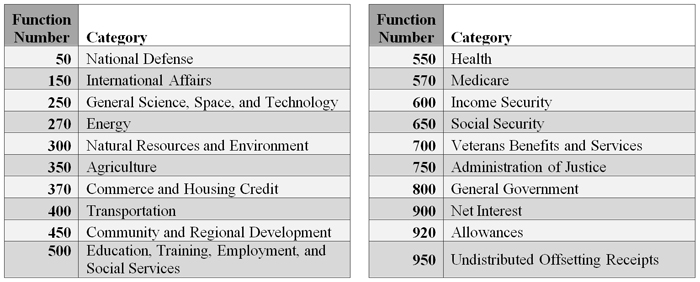
Budget Functions
Resolution Provisions
Title I
Spending
The Democratic budget resolution contains total 10-year spending of $46.4 trillion, an increase of $645 billion over a current law baseline that excludes war spending. Total spending in 2023 is $5.7 trillion – 21.9 percent of GDP. Interest spending in 2023 will total $791 billion.
In its baseline, the budget resolution includes a repeal of the Budget Control Act sequester, estimated by the CBO to cost $995 billion, plus interest savings of $228 billion. Many Republican Senators criticized this assumption during the Budget Committee’s markup. By assuming that the sequester is canceled, but not proposing any specific offset, the Democratic budget falsely claims $1.2 trillion in higher deficit reduction.
The resolution would increase mandatory spending by $25 billion over the 10-year period. This includes spending cuts of $275 billion in health mandatory programs, $23 billion in agriculture program savings, and $39 billion in higher fee collections. However, this is more than offset by spending increases such as a permanent “doc fix,” extension of ARRA refundable tax provisions, and eliminating the sequester for both Medicare and other mandatory spending.
Overseas Contingency Operations funding is $50 billion in 2014 and $25 billion in 2015. No OCO funding is provided in this resolution after 2015. This has the effect of potentially understating future deficits.
Revenues
The total tax increase in the Democratic budget resolution is a minimum of $923 billion over ten years. If reserve funds relating to sequester repeal and stimulus are used as recommended by Budget Committee Chairman Murray in her report, that tax increase would reach $1.5 trillion. The Democrats include reconciliation instructions for $975 billion in increased revenue, but compared to a current law baseline, the revenue increase is actually $923 billion. Chairman Murray also proposes $100 billion in tax increases through eliminating tax expenditures in order to offset an infrastructure stimulus package assumed by the budget resolution. Then add an additional $480 billion that is assumed to offset the sequester since the Democrats assume that the sequester is offset with 50/50 spending cuts to revenue increases. This brings the total tax increase under the Democratic budget to $1.5 trillion – the largest tax increase in the history of the United States.
The Democratic budget resolution’s total 2023 revenues are $5.1 trillion, or 19.8 percent of GDP. This revenue level is highly optimistic, since this percentage of revenue has only been reached five times since 1930.
Deficits and Debt
Democrats say that their budget resolution reduces deficits by $1.85 trillion. However, as discussed above, actual deficit reduction is significantly less since the sequester is canceled but no offset is specifically provided. Canceling the sequester costs $995 billion, but including debt service costs increases that total to $1.2 trillion.
At the Budget Committee’s markup, a Democratic staffer told Senator Mike Crapo that the Democratic budget achieved zero deficit reduction in the first year, 2014. In fact, compared to CBO’s baseline, the Democratic budget adds to the deficit – CBO’s baseline 2014 deficit is $616 billion, while the Democratic budget’s 2014 deficit is $693 billion.
Gross debt at the end of the 10-year budget window will be $24.4 trillion, or 94 percent of GDP.
Title II - Reconciliation
Section 201 –
The Finance Committee is required to report a reconciliation bill by October 1, 2013, that raises revenue by $975 billion (relative to a current policy baseline that includes temporary increases in refundable tax credits that are scheduled to expire in 2018). Relative to the CBO current law baseline, this would be $923 billion in increased revenue.
Title III – Reserve Funds
Reserve funds allow the Budget Committee Chairman to change numbers contained in an already-passed budget resolution if certain legislation is considered. This allows the legislation to be considered without a budget point of order against it for violating the levels contained in the budget resolution. Reserve funds only allow numbers to be changed in the budget resolution; they do not expedite floor consideration of legislation. These number changes can have the effect of allowing spending increases to be offset by tax increases. All of the reserve funds except one are deficit neutral reserve funds (DNRF), meaning the legislation could not add to the deficit, but as noted, could add to both spending and taxes. The reserve fund in Section 306 for tax reform does not have a deficit-neutral requirement.
Section 301 –
DNRF to eliminate sequestration required under Section 251A of the Balanced Budget and Emergency Deficit Control Act of 1985 (as amended by Section 302 of the Budget Control Act of 2011).
Section 302 –
Multiple DNRFs for legislation regarding: (1) employment and job growth; (2) assistance to small businesses; (3) unemployment compensation or assistance; and (4) trade, including Trade Adjustment Assistance.
Section 303 –
Multiple DNRFs for legislation regarding: (1) Social Services Block Grant, Temporary Assistance for Needy Families, child support enforcement, or “other assistance to working families”; (2) rental assistance to families or the assistance via the Housing Trust Fund; and (3) child welfare programs and/or the federal foster care payment system.
Section 304 –
Multiple DNRFs for legislation regarding: (1) pre-K programs to assist low-income children; (2) child care assistance for families; (3) a “home visiting program” serving low income families and low income expectant mothers.
Section 305 –
DNRF for tax relief, including refundable tax relief and relief aimed at innovation or startup companies.
Section 306 –
Reserve fund for tax reform makes the tax system “fairer,” more progressive and more efficient, and improves the business environment for U.S. businesses. While this is not a deficit-neutral reserve fund, under the Budget Act any tax reform legislation that would reduce revenues would be subject to a 60-vote point of order for breaching the revenue floor. Consequently, the reserve fund effectively facilitates only tax reform that increases revenues.
Section 307 –
DNRF for legislation that does any of the following: (1) reduce imported energy and improve domestic production; (2) renewable energy; (3) Low-Income Home Energy Assistance Program; (4) land and water acquisition or conservation; (5) greenhouse gases; (6) public lands, oceans, coasts, and aquatic ecosystems; (7) U.S. and former trust territory agreements; (8) wildland fire management; and (9) restructuring the nuclear waste program.
Section 308 –
DNRF for federal financing or financing through tax-credit bonds of transportation, housing, energy, water, or telecommunications. The Democratic explanatory document envisions a $100 billion infrastructure stimulus package that is offset by eliminating tax expenditures.
Section 309 –
DNRF for service members and veterans for concurrent receipt, reduction/elimination of the offset between Survivor Benefit Plan annuities and Veterans’ Dependency and Indemnity Compensation, disability benefit improvements, Veterans Affairs’ infrastructure needs, and transitioning veterans to the civilian workforce.
Section 310 –
DNRF to make higher education more accessible and affordable.
Section 311 –
Multiple DNRFs for: (1) increase payments under or replace the Medicare Sustainable Growth Rate; (2) extend expiring health care policies; (3) improve the health care delivery system; (4) protect access to outpatient therapy services; and (5) drug safety including importation of FDA-approved prescription drugs.
Section 312 –
DNRF for reauthorization of the Secure Rural Schools and Community Self Determination Act of 2000 and/or the Payments in Lieu of Taxes Act of 1976.
Section 313 –
DNRF for farm bill reauthorization.
Section 314 –
DNRF for water infrastructure or changes to the Harbor Maintenance Tax.
Section 315 –
DNRF for pension reform.
Section 316 –
DNRF for government-sponsored enterprise reform, provide for mortgage refinance opportunities or otherwise promote access to mortgage credit.
Section 317 –
DNRF for Department of Defense audit or acquisition reform.
Section 318 –
DNRF for Overseas Contingency Operations.
Section 319 –
DNRF for reauthorization of the Terrorism Risk Insurance Act.
Section 320 –
DNRF for U.S. Postal Service reform.
Section 321 –
Deficit-reduction reserve fund for government efficiency reform, sale of federal property, and reducing improper payments. This section also allows lowering amounts on the Senate’s PAYGO scorecard to reflect the amount of deficit reduction achieved under this section to ensure that the savings are not offset with spending increases.
Section 322 –
DNRF to improve processing of federal employee benefits or other efficiencies.
Section 323 –
DNRF to improve voter registration and voting in federal elections.
Section 324 –
DNRF for corporate tax “fairness” that may address “loopholes.”
Section 325 –
DNRF to improve federal forest management.
Section 326 –
DNRF for transparency regarding federal agencies’ financial and performance information.
Section 327 –
DNRF to promote manufacturing, which may include educational initiatives, research and development, public-private partnerships or other initiatives.
Section 328 –
DNRF to eliminate or reduce the number of congressionally mandated reports from federal agencies.
Section 329 –
DNRF for an increase in the minimum wage.
Section 330 –
DNRF to improve outcomes and lower costs for children in Medicaid.
Section 331 –
DNRF for federal workforce development, job training, and reemployment programs.
Title IV – Budget Process
Subtitle A – Budget Enforcement
Section 401 –
This section sets Senate-only spending caps for fiscal years 2013 and 2014. These spending caps are those already in effect post-sequester under the Budget Control Act (BCA). This section provides for the same adjustments allowed under the BCA (war spending, emergency spending, disaster spending, and program integrity spending for disability reviews and health care fraud), but limits the increases in the caps for OCO spending to $99.67 billion in fiscal year 2013 and $50 billion in fiscal year 2014. OCO-designated spending beyond those amounts would be subject to a 60-vote point of order.
Section 402 –
This section restates a point of order against advance appropriations for fiscal years 2014 and 2015. This point of order had been in effect under S. Con. Res. 13, the last budget resolution to be agreed to by the House and Senate.
Section 403 –
This section allows the 302(a) committee allocations to be adjusted: (1) if the Budget Control Act sequester takes place; or (2) if it is replaced in whole or in part.
Section 404 –
This section establishes a point of order against any change in mandatory spending program (CHIMP) in appropriations legislation that affects the Crime Victims Fund.
Subtitle B – Other Provisions
Section 411 –
This section directs committees to review programs and tax expenditures under their jurisdiction and report recommendations for improvement in their views and estimates on the President’s budget.
Section 412 –
This section requires that discretionary administrative expenses of the Social Security Administration and Postal Service be included in the 302(a) allocation to the Committees on Appropriations.
Section 413 –
This section states the procedures for altering numbers in this budget resolution for purposes of budget enforcement on the Senate floor .
Section 414 –
This section allows changes in numbers due to enacted changes in budgetary concepts and definitions.
Section 415 –
This section states the rulemaking authority under which the Senate adopts the provisions of Title IV.
Title V – Other Matters
Section 501 –
This section requires CBO to report annually on the fiscal effects of the President’s health care law.
Section 502 –
This section requires CBO to provide an annual estimate of effects of the President’s health care law with assumptions that 30 percent, 50 percent, and 100 percent of Americans lose employer sponsored health coverage.
Administration Position
While the President is not involved in the congressional budget resolution, typically there is a President’s budget submission to compare to the budget resolution. However, this is the first non-transition year in the modern budget process that Congress has begun consideration of a budget resolution before the President’s budget has been submitted. The President’s budget is expected on April 8, 63 days after the legal deadline of February 4.
Cost
The Congressional Budget Office does not score budget resolutions since a budget resolution does not change current law. The Senate Budget Committee Republicans estimate that this budget resolution increases spending by $645 billion over 10 years and increases taxes by between $923 billion and $1.5 trillion. The national debt in 2023 would total $24.4 trillion, or 94 percent of GDP.