Legislative Notice: H.J.Res. 59 – Continuing Appropriations Resolution, 2014
Noteworthy
- Background: H.J.Res. 59 was introduced on September 10. The House passed H.J.Res. 59 on September 20 by a vote of 230-189. Before passing the legislation, the House amended the original measure by adding the text of H.R. 2682 (the Defund Obamacare Act) and H.R. 807 (the Full Faith and Credit Act).
- Floor Situation: The Senate is expected to consider the CR during the week of September 23. The following is a possible timeline for consideration of H.J. Res. 59, assuming that all post-cloture time is used and no agreement is reached to streamline consideration: Today, Majority Leader Reid will file cloture on the motion to proceed to H.J. Res. 59. On Wednesday, as early as 1:00 a.m., the Senate will vote on the motion to invoke cloture on the motion to proceed. If cloture is invoked on the motion to proceed and all 30 hours of post-cloture time are used, sometime on Thursday Majority Leader Reid will introduce an amendment or motion to remove the Obamacare language from the bill and fill the amendment tree (it is uncertain whether a motion to strike, a substitute amendment, or another mechanism will be used). He will then file cloture on H.J. Res. 59. On Saturday morning, as early as 1:00 a.m., the Senate will vote on the motion to invoke cloture on H.J. Res. 59. If cloture is invoked, during the 30 hours of post-cloture debate time, the Senate will vote on removing the Obamacare language. If all post-cloture time is used, sometime on Sunday the Senate will vote on passage of H.J. Res. 59 and send it back to the House. Note: Post-cloture time starts when a cloture vote ends. For example, if the cloture vote on the motion to proceed ends at 1:30 a.m. Wednesday, the 30 hours will expire at 7:30 a.m. Thursday.
- Executive Summary: H.J.Res. 59 is a continuing resolution for the federal government until December 15, 2013. CBO reports that this CR would fund the federal government at an annualized rate of $986.263 billion in fiscal year 2014 regular discretionary budget authority. This is slightly less than the current 2013 spending of $988 billion.
Overview
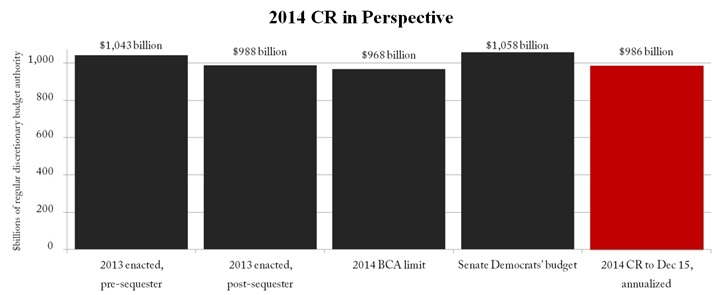
H.J.Res. 59 funds the federal government until December 15, 2013, at an annualized level of $986.263 billion in regular discretionary budget authority. Totals for “regular” funding exclude Overseas Contingency Operations ($94.9 billion provided in the CR), disaster relief ($6.1 billion) and program integrity initiatives ($471 million). The regular budget authority provided by the CR is above the maximum 2014 funding allowed under the Budget Control Act (BCA) of an estimated $967.5 billion. This maximum funding level is the result of two separate BCA caps – a cap on defense funding of $498.1 billion, and a cap on non-defense of $469.4 billion. The CR provides $518 billion in regular funding for defense activities, and $468.2 billion in regular funding for non-defense activities.
CRs are traditionally a continuation of the prior year’s spending level. While this CR includes annualized funding greater than that allowed by the BCA, the funds it provides would not be subject to a BCA sequester since this continuing resolution expires on December 15. If this CR is eventually extended to cover the full fiscal year, then the funds will be subject to a sequester 15 days after the end of session. CBO reports that the Defense funding is the only portion of the CR that would be subject to a sequester if it were extended for the entire fiscal year. Annualized defense funding in the CR is $19.9 billion higher than the BCA’s 2014 defense cap, while annualized non-defense funding in the CR is $1.1 billion less than the non-defense cap. Compared to fiscal year 2013, the funding level in the House CR is slightly less than the 2013 post-sequester regular funding level of $988 billion.
The estimate for total 2013 regular funding levels has changed since the enactment of H.R. 933, the final fiscal year 2013 appropriations legislation. During consideration of H.R. 933, CBO had said that the bill would provide $984 billion in post-sequester regular funding ($1.043 trillion less $59 billion from the sequester). However, that number changed to $988 billion after OMB lowered their estimate of the amount of discretionary budget authority that would be sequestered.[1]
CBO has estimated that simply extending 2013 funding into 2014 would result in regular discretionary budget authority of $989 billion, so the changes included in the House CR have, on net, reduced spending by approximately $2.7 billion compared to a “clean” CR.
H.J.Res. 59 contains $18.145 billion in CHIMPS for fiscal year 2014.
Bill Provisions
Section 101
This section provides budget authority in fiscal year 2014 for projects and activities that were funded in fiscal year 2013. The rate of funding in 2014 is equal to that provided in 2013.
Section 102
This section prohibits the Department of Defense from funding new projects, activities, etc. that were not funded in 2013.
Section 103
This section provides that the fiscal year 2014 CR funding shall be governed by provisions in the applicable appropriations act.
Section 104
This section states that no project or activity may receive funds if it was not funded in fiscal year 2013.
Section 105
This section provides that the fiscal year 2014 CR covers all obligations and expenses during the period of the CR.
Section 106
This section states that the CR will last until December 15, 2013.
Section 107
This section provides that expenditures made under this CR will count toward funding totals when final appropriations legislation is enacted.
Section 108
This section allows the use of CR funds regardless of a timeline governing apportionments contained in 31 USC 1513. Identical language was included in CRs during the 112th Congress.
Section 109
This section prevents agencies that typically have high rates of outlays at the beginning of the fiscal year from making these outlays. This is done to preserve Congress’ ability to lower spending levels later when final appropriations legislation is considered.
Section 110
This section requires agencies to outlay as little funding as possible to continue projects and activities.
Section 111
This section allows mandatory outlays to continue at rates provided for in current law.
Section 112
This section provides flexibility under the current rate for agencies to allocate salary and benefit funding to avoid furloughs in certain circumstances; but only if the agency has already taken all actions to lower and delay non-personnel administrative expenses.
Section 113
This section allows CR funds to be obligated and spent, notwithstanding several provisions of the U.S. Code that prohibit obligation and expenditure of an appropriation that is unauthorized or exceeds the authorized amount: (1) 22 USC 2412 regarding foreign assistance; (2) 22 USC 2680 regarding the State Department; (3) 22 USC 6212 regarding the Broadcasting Board of Governors; (4) 50 USC 414(a)(1) regarding intelligence.
Section 114
This section makes budgetary designations for GWOT/OCO funding, disaster funding, and Social Security administrative funding. It adopts a provision in P.L. 113-6 (H.R. 933) that requires the President to ratify the budgetary designation for GWOT/OCO.
Section 115
This section requires executive branch officials to submit a report to their inspectors general that details conferences that cost taxpayers more than $100,000. The section also requires inspectors general notification for conferences that cost more than $20,000. This requirement was also included in the final fiscal year 2013 funding act, P.L. 113-6.
Section 116
This section extends the Food for Peace Act until December 15, 2013.
Section 117
This section allows expenditures for work to continue on two weather satellites.
Section 118
This section allows expenditures to continue under Section 1206 of the 2012 National Defense Authorization Act. That section authorizes assistance to foreign forces participating in operations to disarm the Lord’s Resistance Army.
Section 119
This section continues authorization for the Appalachian Regional Commission until December 15, 2013.
Section 120
This section allows the District of Columbia to spend local funds in accordance with the provisions included in H.R. 2786, the House Financial Services and General Government Appropriations Act, 2014.
Section 121
This section changes funding for Defender Services under “The Judiciary – Courts of Appeals, District Courts, and Other Judicial Services” to an annualized rate of $1.012 billion.
Section 122
This section extends through December 15, 2013, the authority of various interim DHS regulations regarding the security of chemical facilities.
Section 123
This section extends through December 15, 2013, current law regarding the Secret Service’s use of proceeds derived from criminal investigations.
Section 124
This section extends through December 15, 2013, current law regarding DHS’ authority regarding research and development projects.
Section 125
This section allows U.S. Customs and Border Protection and U.S. Immigration and Customs Enforcement to obligate funding at a rate necessary to keep agent numbers at the level of September 30, 2013.
Section 126
This section appropriates an additional $36 million for operations for the Department of the Interior’s Wildland Fire Management. This funding is available until expended – it does not expire with the rest of the CR.
Section 127
This section appropriates an additional $600 million for the Department of Agriculture’s Forest Service Wildland Fire Management program, but only if previously appropriated funds for this activity “will be exhausted imminently.” This funding is available until expended – it does not expire with the rest of the CR.
Section 128
This section extends until December 15, 2013, the authority for the Forest Service regarding the “Stewardship End Result Contracting Demonstration Project” contained in section 347 of P.L. 105-277.
Section 129
This section extends the expiring authorization for funding for the Temporary Assistance for Needy Families to states and territories through December 15, 2013.
Section 130
This section increases the amount of user fees the Mine Safety and Health Administration is allowed to retain and use, from $1.499 million to $2.499 million.
Section 131
This section updates the fiscal year in a proviso that directs how funding is allocated for the Low Income Home Energy Assistance Program.
Section 132
This section allows Refugee and Entrant Assistance to be spent at a rate for operations needed to maintain the service level provided in 2013.
Section 133
This section allows funding to be taken from Health and Human Services’ Nonrecurring Expenses Fund (used for capital acquisition) and used instead for public health emergency preparedness.
Section 134
This section appropriates payment of $174,000 to the widow of late Senator Frank Lautenberg.
Section 135
This section increases the rate for operations for the Department of Veterans Affairs’ operating expenses of the Veterans Benefits Administration by $291 million to $2.455 billion.
Section 136
This section extends until December 15, 2013, HUD’s authority to continue Rental Assistance Demonstration projects.
Section 137
The House added this section into the base text of H.J.Res. 59. This section provides that no funds may be used to implement the President’s health care law and otherwise eliminates any entitlement to benefits that may accrue under that law. The text of this section is identical to H.R. 2682.
Section 138
This section includes the text of H.R. 807 as passed by the House, modified to limit its application until December 15, 2013. This section authorizes the Treasury Secretary to pay Social Security benefits and principal and interest payments on government debt in the event that the U.S. reaches the debt limit and all extraordinary actions to continue operations have been exhausted. The payments made under this authority are exempt from the debt limit, but only if they would otherwise cause the debt limit to be exceeded. The section further provides that the authority cannot be used to pay compensation for Members of Congress. The section requires that Treasury report to Congress on the use of the authority provided by this section.
Administration Position
The Administration has vowed to veto H.J.Res. 59.
Cost
CBO reports that H.J.Res. 59 would provide an annualized level of $986.263 billion in regular discretionary budget authority. H.J.Res. 59 also provides $94.9 billion in Overseas Contingency Operations funding, $6.1 billion in disaster relief, and $471 billion in program integrity initiatives. The regular budget authority provided by the CR is above the maximum 2014 funding allowed under the BCA of an estimated $967.5 billion. This maximum funding level is the result of two separate BCA caps – a cap on defense funding of $498.1 billion, and a cap on non-defense funding of $469.4 billion. The CR provides $518 billion in regular funding for defense activities, and $468.2 billion in regular funding for non-defense activities.
Possible Amendments
The amendment situation is unclear at this time.